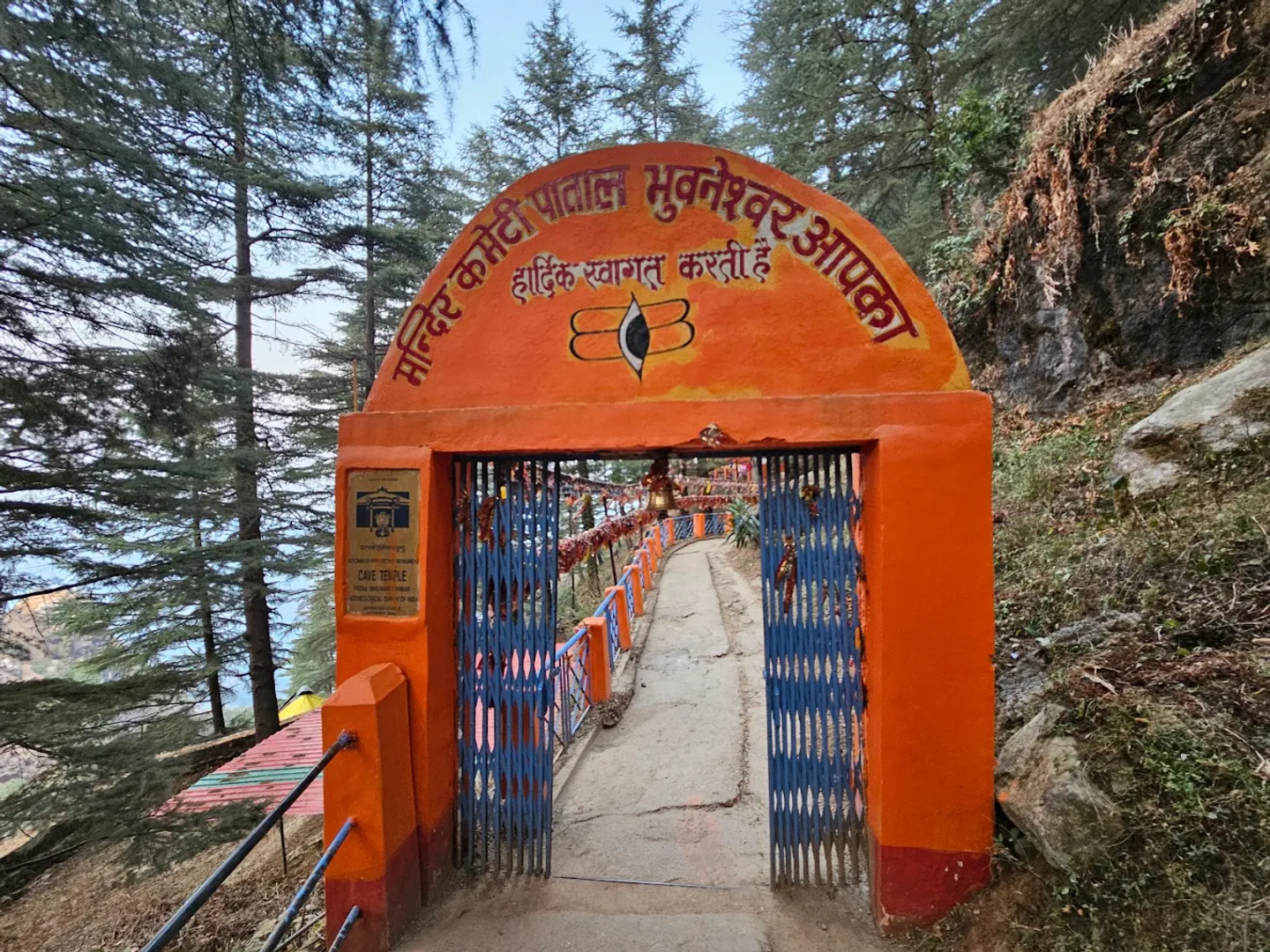
Patal Bhuvneshwar Cave Temple
Descend into the subterranean sanctum where Lord Shiva's silent universe is carved in living rock
Distance
~190 km
Duration
Starting from
Patal Bhuvneshwar Cave Temple
The Subterranean Shrine Where 33 Crore Deities Dwell in Stone
📜 The Legend of the Hidden Sanctum
Legend holds that this cave was first discovered by King Rituparna of Ayodhya, guided by the sage Markandeya, and that the Pandavas visited during their exile to pay homage to Lord Shiva in this concealed form. In the 8th century, Adi Shankaracharya is said to have entered the cave, widened its narrow passage, and installed a Shiva Lingam within, formally establishing it as a place of pilgrimage.
Inside, the natural limestone formations are read by pilgrims as a living map of the cosmos: coils of rock said to be the great serpent Sheshnag, an udder-shaped formation identified as Kamdhenu, and chambers named for Kedarnath, Amarnath, and Badrinath. A narrow passage known as the Kalyug Dwar (Gate of the Kali Yuga) is said to be sealed shut, its slow closing a portent of the world's end.
Key Highlights
- Subterranean limestone cave temple believed to house 33 crore (koti) deities in natural rock form.
- Dramatic rock formations identified by pilgrims as Sheshnag, Kamdhenu, and the four Yugas.
- Mythologically linked to the Pandavas, sage Markandeya, and Adi Shankaracharya.
- A narrow, priest-guided descent through rope-and-chain passages, including the symbolic Kalyug Dwar.
Pithoragarh
District
Shiva Temple
Type
~190 km
From Kathgodam
Temple Timings
Pooja/Aarti Timings
Morning and evening aarti conducted by resident priests
Book a Taxi to This Temple
Reliable taxi service from Kathgodam to this sacred destination
History & Significance
✨ Spiritual Significance
- 🕉️ The Abode of 33 Crore Deities: Every fold and contour of the cave's limestone walls is interpreted by pilgrims and priests as a natural rock form of a different deity, making the cave itself a living, breathing shrine.
- 🐍 The Coils of Sheshnag: A dramatic rock formation resembling the thousand-hooded serpent upon which Lord Vishnu reclines dominates one chamber of the cave.
- 🚪 The Four Yugas: Four narrow openings inside the cave are associated with the four ages of Hindu cosmology — Satya, Treta, Dwapar, and Kali — with the Kali Yuga passage said to be gradually narrowing.
🎨 Geological Character
- 🪨 Natural Limestone Karst: Unlike the built stone temples elsewhere in Kumaon, Patal Bhuvneshwar is entirely a natural cave system, its stalactite and stalagmite formations shaped over millennia.
- 🕯️ Descent by Rope and Chain: Pilgrims descend through a narrow, low-ceilinged passage using iron chains and rope handholds fixed into the rock, led by a temple priest carrying a lantern.
- 💧 Perpetual Cave Springs: Small natural springs inside the cave are believed to be the sacred waters of the Ganga, Yamuna, and Saraswati.
🧳 Traveler's Guide
- 📍 Location: Near Gangolihat town, Pithoragarh district, roughly 14 km from Gangolihat itself.
- 📅 Best Time to Visit: March to June and September to November; the monsoon months (July–August) bring landslide risk on the mountain approach roads.
- 🚶 Accessibility: Moderate to challenging — the cave interior requires crouching, crawling, and descending narrow rock passages; not suited to those with mobility limitations or claustrophobia.
🙏 Rituals & Festivals
- 🔥 Maha Shivratri: The temple sees its heaviest pilgrim footfall, with devotees queuing to descend into the cave and offer prayers at the Shiva Lingam within.
- 🪔 Regular Aarti: Resident priests conduct daily rituals at the cave mouth and guide pilgrims through the descent with oil lamps.
📍 Nearby Attractions
- 🛕 Haat Kalika Temple, Gangolihat (14 km): An important Shakti Peetha dedicated to Goddess Kalika.
- 🍃 Berinag (35 km): Known for its tea gardens and panoramic Himalayan views.
- 🏔️ Chaukori (45 km): A quiet hill town with sweeping views of the Panchachuli peaks.
Choosing Your Taxi: Sedan vs SUV/Innova
How to Reach Patal Bhuvneshwar Cave Temple
From Kathgodam
Approx. 190 km, 6–7 hours via Bhowali, Almora, and Berinag.
Nearest Railway Station
Kathgodam Railway Station (~190 km)
Nearest Airport
Pantnagar Airport (~210 km)
Pilgrimage Tips
- Wear closed, non-slip footwear — the cave floor is uneven and slippery in places.
- Be prepared to crouch, crawl, and use fixed iron chains during the descent; this is not suited to those with mobility or breathing difficulties.
- Follow the temple priest's guidance closely during the descent — the passage is narrow and unlit beyond the priest's lantern.
- Leave bags, large cameras, and leather items outside the cave entrance as required.
Best Time to Visit
March to June and September to November offer the clearest mountain roads and pleasant weather; the July–August monsoon is best avoided due to landslide risk on the approach road.
Frequently Asked Questions
What are the temple's entry timings?
Do I need a guide to enter the cave?
Is the cave difficult to enter?
Which months are best to visit?
Can I carry a camera or bag inside the cave?
Ready to Visit Patal Bhuvneshwar Cave Temple?
Book a comfortable taxi from Kathgodam to Patal Bhuvneshwar Cave Temple. Fixed prices, reliable drivers, and hassle-free pilgrimage experience.